
England could scrap universal free museum entry
Government exploring new fees for tourists

Friday 27 March 2026 | news from the world of museums, galleries, art and heritage
Happy Friday.
Charging international visitors to enter England's national museums now looks increasingly likely as the government says it believes the move "could provide significant benefits."
The Department for Culture, Media and Sport (DCMS) says it will work with the sector to "explore" introducing these new fees, as part of its official response to Baroness Hodge's recent review of Arts Council England. The government are accepting every recommendation made in the Hodge Review.
But it’s the revelation that fees will be considered that has understandably proved the biggest bombshell. And it has sucked much of the attention away from how Arts Council England will now be reformed (they have no control of entry fees).
So once again here’s my assessment: introducing entry fees is a bad idea because the sums do not add up.
And that’s because if fees are introduced, the government will start cutting the grant-in-aid given to our museums. Perhaps not immediately, but we already know the Treasury is desperate to stop paying the £480m it gives them annually, and last year’s Budget tried to abolish free entry to do just that. The plans were eventually scrapped after strong resistance from culture ministers.
In February, V&A Director Tristram Hunt said the same thing. “The Treasury has a nasty habit of lowering public funding as it sees self-generated income growing” he wrote in the FT. So charges will ultimately only spawn much deeper and more significant cuts from the state subsidy. It could even land museums a net loss.
And incredibly, there’s not even any guarantee the institutions will get to keep any of admission fees. In the government’s response this week, ministers don’t sound like they’re mindful to ensure that they will. Charges “could underpin our commitment to ensure art and culture is accessible, representative and shared across the country" they say. They could also “deliver benefits for the sector” — emphasis my own.
Crucially, I think it’s important to remember that there are 15 museums and galleries funded by the Department for Culture, Media and Sport (although what this means for the three national museums funded by the Ministry of Defence is a whole other question).
Inevitably, the people in favour of charging almost exclusively use the British Museum and its queues of tourists to support their argument. But the nationals are much more varied.
The proportion of international visitors to the Science Museum is roughly 30%. But to the National Railway Museum, it’s 8%. Both are in the Science Museum Group, so will the Science Museum’s tourist fees need to subsidise its other sites with far fewer foreign visitors? The National Gallery doesn’t need to worry about that, how would that be fair?
Imperial War Museums (IWM) already charge EVERY VISITOR entry to some sites. So the potential size of new revenue will be much smaller. Two of their admission-charging venues continue to lag pre-pandemic visitor levels — Churchill War Rooms is 13% down, and HMS Belfast is 37% down. I don't think IWM would argue charging has been a magic bullet for their finances.

Will National Museums Liverpool need to charge all tourists? If so, what does that do to tourist levels and the attractiveness of visiting Liverpool? Isn't the government hoping to encourage tourism out of London?
And will tourists be able to afford as many visits as some do now? The British Museum and Tate Modern are (and will remain) the first and second choices for the vast majority, while the Soane Museum and Wallace Collection usually pick up third and fourth choice visits. If they are no longer all free, will people have enough means to make multiple visits, or will the smaller nationals begin to miss out?
These questions rarely feature in most debates about the issue. But they are the reality of the policy. I think there’s no reason to be confident new admission fees will make England’s national museums more financially sustainable.
The best way to do that, in my view, is an overnight tourist tax for hotels and Airbnbs, which is also championed by Sir Tristram Hunt. It’s also supported by the Financial Times’ Stephen Bush, who very kindly mentioned this newsletter in his own FT newsletter Inside Politics this morning, as well as referencing some of my points laid out here. (Thank you!)
I’m sure Stephen, myself, Tristram and the whole of Britain’s museum world will be returning to this debate many times in the coming weeks and months.
So for now, let’s head into this week’s news!
maxwell
— AD
Discover why Tracey Emin paints

Tracey Emin is a tour de force. I saw that up close last week at an event to launch her new book about her relationship with painting.
The book’s called My Heart is This, and it’s a series of raw and confessional interviews with art critic Martin Gayford. It’s a must-read for anyone who wants to get under the skin of what makes her paint.
The launch saw Tracey dive into her career, and the sell-out crowd heard frank talk about how her painting has all changed since her cancer diagnosis.
The thing that struck me most? When Tracey movingly explained the mutual dialogue with her finished works. She said that once completed, “the painting then tells me something about myself, that I didn’t know.”
I can’t wait to get stuck into the book after hearing the extraordinary stories in the talk. I think after reading it, the next time you stand in front of one of her paintings, you’ll practically feel Dame Tracey pouring her heart into the canvas.
Top stories 🚨
Happiness! in Liverpool thanks to Ken Dodd
The performing arts charity set up in honour of the great British comedian Sir Ken Dodd (who died in 2018) is to donate a “transformational” £1.5m gift to National Museums Liverpool over the next three years.
The Museum of Liverpool’s theatre will be renamed The Ken Dodd Auditorium and a new permanent Sir Ken Dodd display will open next year to mark the centenary of his birth. The money will also help to grow the museum group’s Under-26 membership scheme, and will fund their award-winning dementia awareness programme.
It comes after the success of the 2024 Happiness! exhibition which celebrated the comedian. But it also follows the charity’s unsuccessful bid to create a £15m permanent museum to Dodd in the city.
Anne, Lady Dodd who runs the foundation, said “Our significant donation will be used to benefit a vast range of programmes I know Ken would be immensely proud to be supporting.” (Read more)
Schiaparelli’s Dalí painting makes UK debut
A Salvador Dalí painting that inspired a famous Schiaparelli dress has gone on public display in UK for the first time.
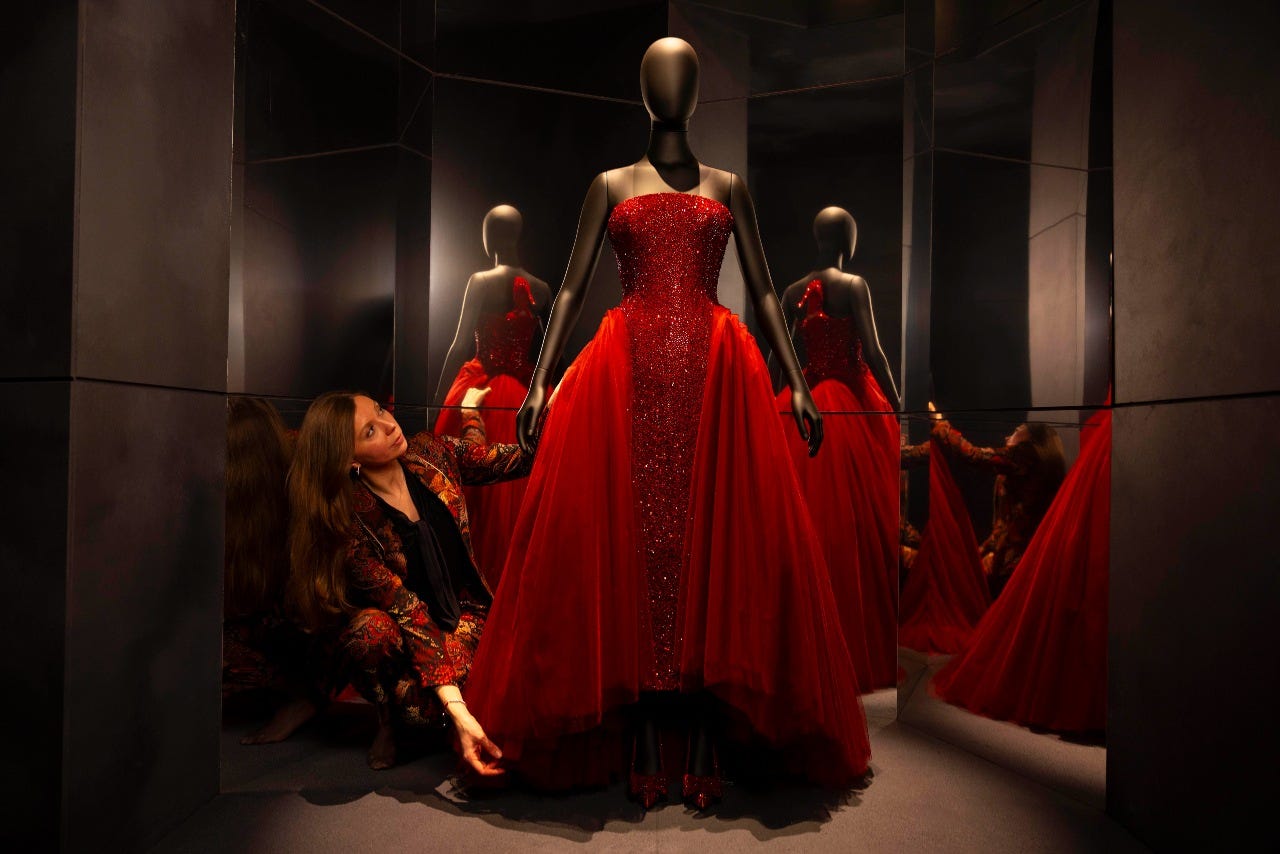
Dalí’s Necrophiliac Spring (1936) was owned by the famed Italian fashion designer Elsa Schiaparelli and inspired one of her most famous creations, the 1938 Tears dress. The painting has not been displayed anywhere for 15 years, but from tomorrow it can be seen at the V&A’s blockbuster Schiaparelli: Fashion Becomes Art exhibition. It was sold at Sotheby’s New York in 2012 for $16.3m, and is on loan to the V&A from a private collection. Visitors will see it alongside the Tears dress from the museum’s collection.
The exhibition — which features over 400 objects, including 100 ensembles and 50 artworks by icons including Picasso, Jean Cocteau and Man Ray — has been unveiled to positive reviews. “Absorbing” was the Times’ verdict, while the Telegraph called it “dazzling.” Tickets for the first month are all sold out. (Read more)
— Please drop me a donation to support this newsletter.
UK news 🇬🇧
Royal Armouries first to defend free entry 💷
The Royal Armouries and its Director Nat Edwards have joined Sir Tristram Hunt in being the first from England’s national museums to come out against any moves to introduce entry fees for international visitors. The Leeds-based museum said in a statement they “have serious reservations about this proposal” while Edwards said it was a “superficial, short-term response.” Hunt said the V&A was not “institutionally attracted to” the proposition. (Read more)
Ai Weiwei to perform for 24 hours ⏰
Artist Ai Weiwei will reenact his secret detention by the authorities in China in 2011 for the first time, in a unique new 24-hour performance piece. Sewing a Button will take place in July at Aviva Studios in Manchester, and will give visitors an unflinching look at the artist’s experience across a single night and day of his 81-day incarceration. Audience members will be able to watch Ai Weiwei sleep, eat, exercise, write, wash and be interrogated. (Read more)
National Gallery taking murals nationwide 🎨
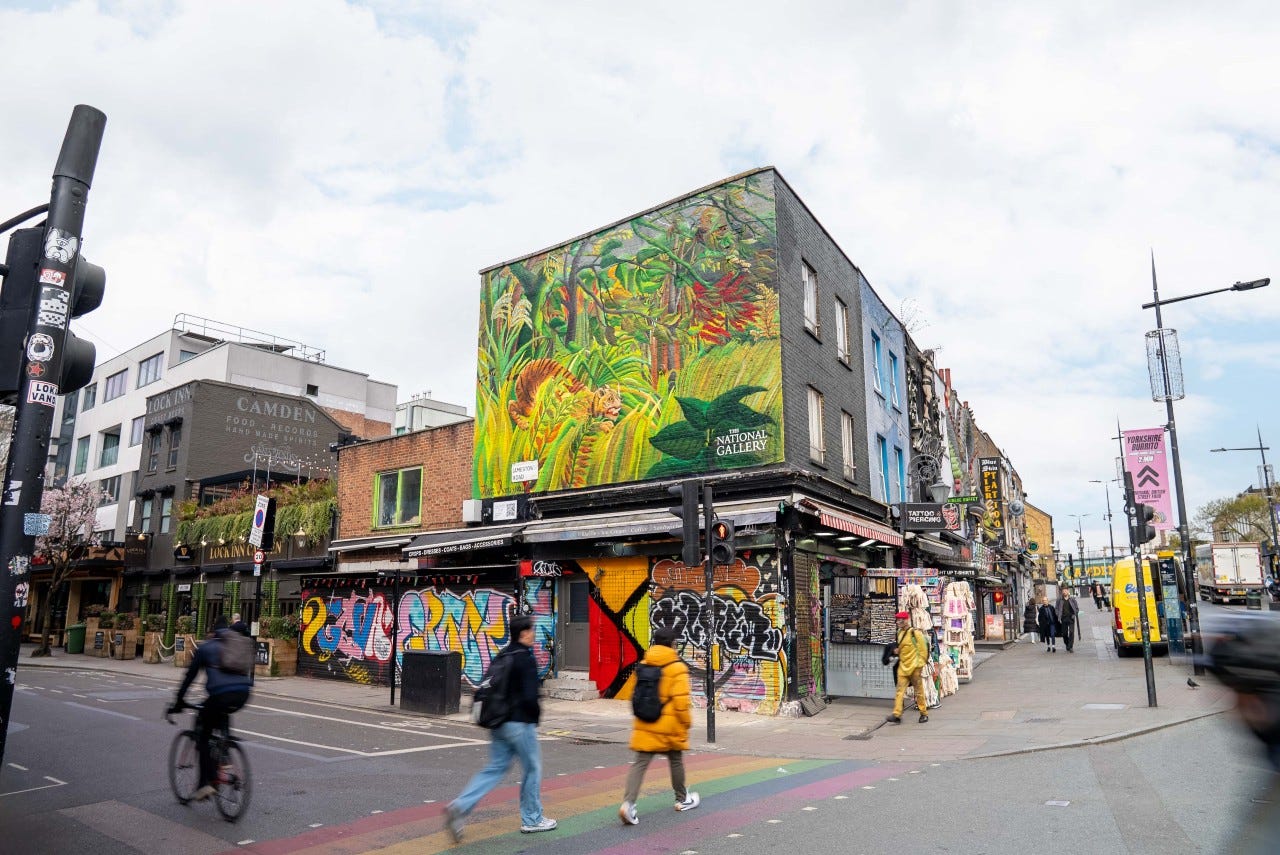
A giant hand-painted recreation of Henri Rousseau’s 1891 jungle scene, Surprised! (Tiger in a Tropical Storm) has been unveiled in Camden, London as part of the a new project by the National Gallery. Over the coming months, works from across the gallery’s collection will be reimagined at huge scale in public places across the UK. The next Murals reMastered works will be unveiled soon in Brent Cross and Carnaby Street. (Read more)
Global news 🌎
USA 🇺🇸
A $13 million project at Brooklyn Museum will see the creation of permanent galleries to display its 4,500-piece African art collection. 300 items will be shown in the new Arts of Africa galleries that will open in the autumn of 2027. “This is more than a new collection gallery — it’s a bold reframing of how African art is understood and celebrated in American museums,” said Director Anne Pasternak. The project is funded by the City of New York and federal grants. (Read more)
Norway 🇳🇴
Manchester City striker Erling Haaland has donated the only surviving copy of a 16th-century book of Viking sagas to his hometown library in Bryne. He purchased the book for 1.3 million Norwegian crowns (£100,000) in December, which was a record for a book sale in Norway. He has gifted the 1594 work so it can go on public display and “so that people can read about those who came from where I come from, from Bryne and Jæren” he said. (Read more)
USA 🇺🇸
A statue of Christopher Columbus has been installed on the grounds of the White House, as part of Trump’s effort to honour the controversial figure. It’s a replica of one that protesters in Baltimore tore down in 2020. It was erected in the middle of the night. “In this White House, Christopher Columbus is a hero, and President Trump will ensure he’s honored as such for generations to come,” said a White House spokesman. (Read more)
USA 🇺🇸
Fiasco for LACMA (Los Angeles County Museum of Art). The museum had nabbed the right to host the Vanity Fair Oscars party because its new editor wanted to revitalise Hollywood’s biggest after-party. Guests were due to get an exclusive first peek at the museum’s new $720m David Geffen galleries, but they weren’t finished in time so an alternate wing had to be used. And then a full-blown scandal hit when the A-listers saw the “unforgiving” photos from the event that went viral. (Read more)
News in brief 🗞️
Before Dolly there was Morag
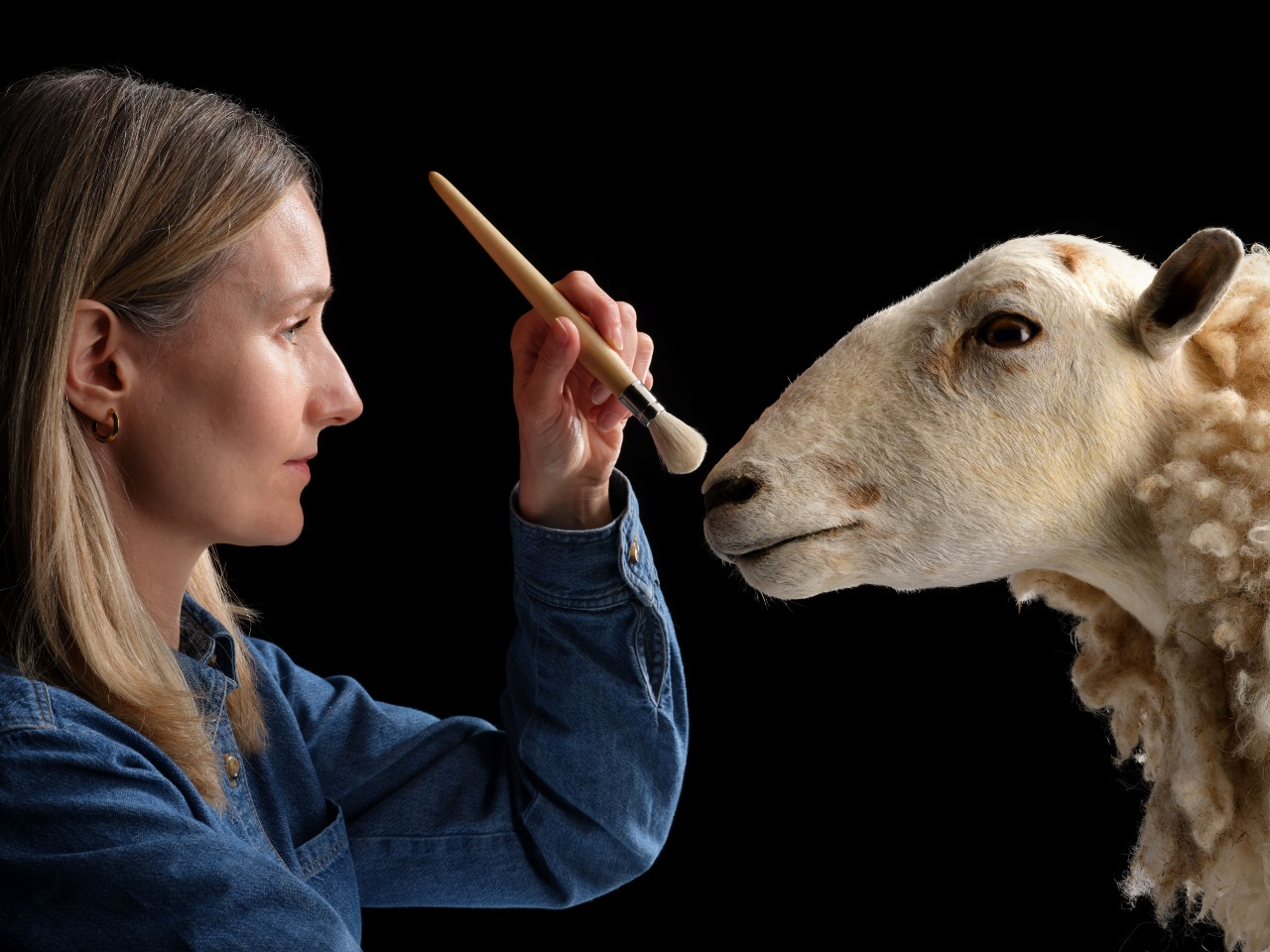
Morag — the cloned sheep that paved the way for the more famous Dolly — has gone on permanent display for the first time in 20 years at Scotland’s National Museum of Rural Life. She’s part of a new display on the future of farming. (Full story)
Scotland’s museum bosses lead QEII memorial
A permanent memorial to Queen Elizabeth II in Scotland has been given the green light. Proposals will be drawn up by an expert panel that includes V&A Dundee director Leonie Bell and Anne Lyden, director of National Galleries of Scotland. (Full story)
Keeper appointed at British Museum
The British Museum have appointed a new Keeper of Africa, Oceania and the Americas, one of their most senior collection positions. Dr Domenico Sergi will join from the London Museum. (Full story)
Museum of London will be demolished
A legal challenge contesting plans to demolish the former Museum of London building to create office blocks has been dismissed. The High Court rejected a judicial review that claimed there was a failure to consider alternative schemes. (Full story)
— Find this newsletter informative, useful or entertaining? Maybe ALL THREE?? Then please drop me a donation to support my work
👀 Last edition’s most clicked stories:
🥇 The Association of Leading Visitor Attractions (ALVA) reveals 2025’s annual attendance numbers
🥈 Blackpool, Ipswich, Milton Keynes among nine finalists for UK City of Culture 2029
🥉 “Boozed up” visitor fears for neighbours of the Quentin Blake Centre for Illustration
📊 Last week’s poll results | How do you rate Tate’s 2027 exhibition line-up?
— ⭐️⭐️⭐️⭐️⭐️ 29%
— ⭐️⭐️⭐️⭐️ 37% 🏆
— ⭐️⭐️⭐️ 23%
— ⭐️⭐️ 6%
— ⭐️ 6%
🗳️ This week’s poll |
I really think culturally as well it would be such a shame to take away the ease of walking into so may galleries and museums in London. I would have thought ticketed systems and having to show your ID, if you indeed have one, would really slow things down. Ethically too, with places like The British Museum, it seems to wrong to charge people from other countries to see items taken from their own country?
Great to see we're on the same page around keeping museums free, and both published on the newsletters on the same day about it - uncoordinated, I might add :). I would also add it's the tourists that spend in the gift shops, so that's another revenue stream that would fall. Plus, there's an administrative cost of managing entry fees that museums would have to absorb, and not all UK residents carry photo ID - though I know they are looking to tie it to ID cards if they ever come along. There's a lot to unpack that hasn't been thought through.
On top of that, there's something wonderful about people discovering art after wandering into a free museum that would be lost. I'm extremely biased, but it's part of what makes London the greatest city in the world :).