
INTERVIEW: National Gallery of Ireland Director Caroline Campbell
What makes a successful 'national gallery'?

Wednesday 28 January 2026 | the Big Interview from the world of museums, galleries, heritage and art
Happy Wednesday.
Today I’m bringing you my first interview of the year.
In October, I flew to Dublin for my first ever visit to the city, to see the National Gallery of Ireland’s Picasso: From the Studio exhibition. The show is another first: Ireland’s first complete survey of Picasso’s work and career in over 50 years.
I saw the 60+ magical loans from the Musée Picasso in Paris, and it was brilliant. If you can get to see it before it closes next month I implore you to do so.
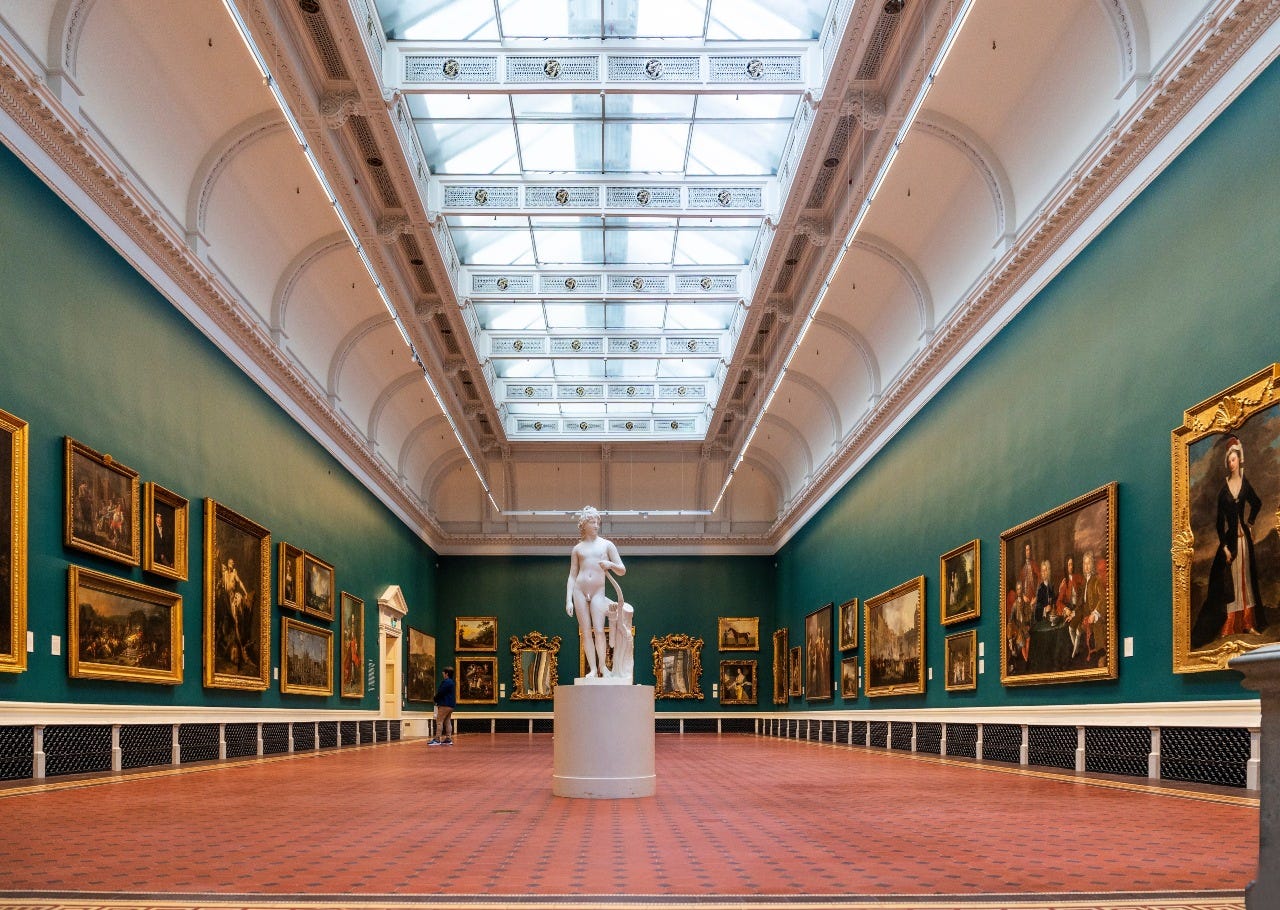
But equally brilliant is the gallery’s permanent collection and displays. There’s Caravaggios, Goyas, Monets and many more knockouts. Despite spending around three hours there, I realised by the time I needed to head home that I’d barely seen more than one floor. The magnificent Grand Gallery alone occupied me for well over an hour.
The Director of the National Gallery of Ireland (NGI) is Dr Caroline Campbell, who has been in post since November 2022. Prior to that she’d been at the National Gallery in London for over a decade, including nearly five years as Director of Collections. It was in this role that I first interviewed Caroline. It was exactly five years ago, and Britain was in its second month of its third pandemic lockdown (the one that lasted a long five months, which I think we would all like to forget).
Visiting Dublin’s National Gallery I wondered how the institution compared to its London counterpart — and naturally Caroline sprang to mind as someone who would absolutely know the answer.
So to mark my first visit to Dublin, I thought Caroline should become the first person to ever do a second interview in my 8-year history of writing this newsletter. Thankfully, she agreed!
Here’s our wide-ranging chat, exploring the huge popularity of the current Picasso exhibition, the question of what makes a successful ‘national gallery,’ and how new legislation in Ireland is moving the gallery towards being fully bilingual. Plus she picks out some of the masterpieces you definitely need to see.
Enjoy!
maxwell
Want to sponsor this newsletter and appear in the inboxes of 6,000 museum and art fans in a future edition? Hit reply to this email and ask me for more details 📩
The Big Interview
How would you sum up the NGI’s 2025?
Very positive. For the third year in a row, we welcomed over one million visitors. We’re very proud of this achievement when you consider it as a percentage of the population of the island of Ireland, which is around 7 million.
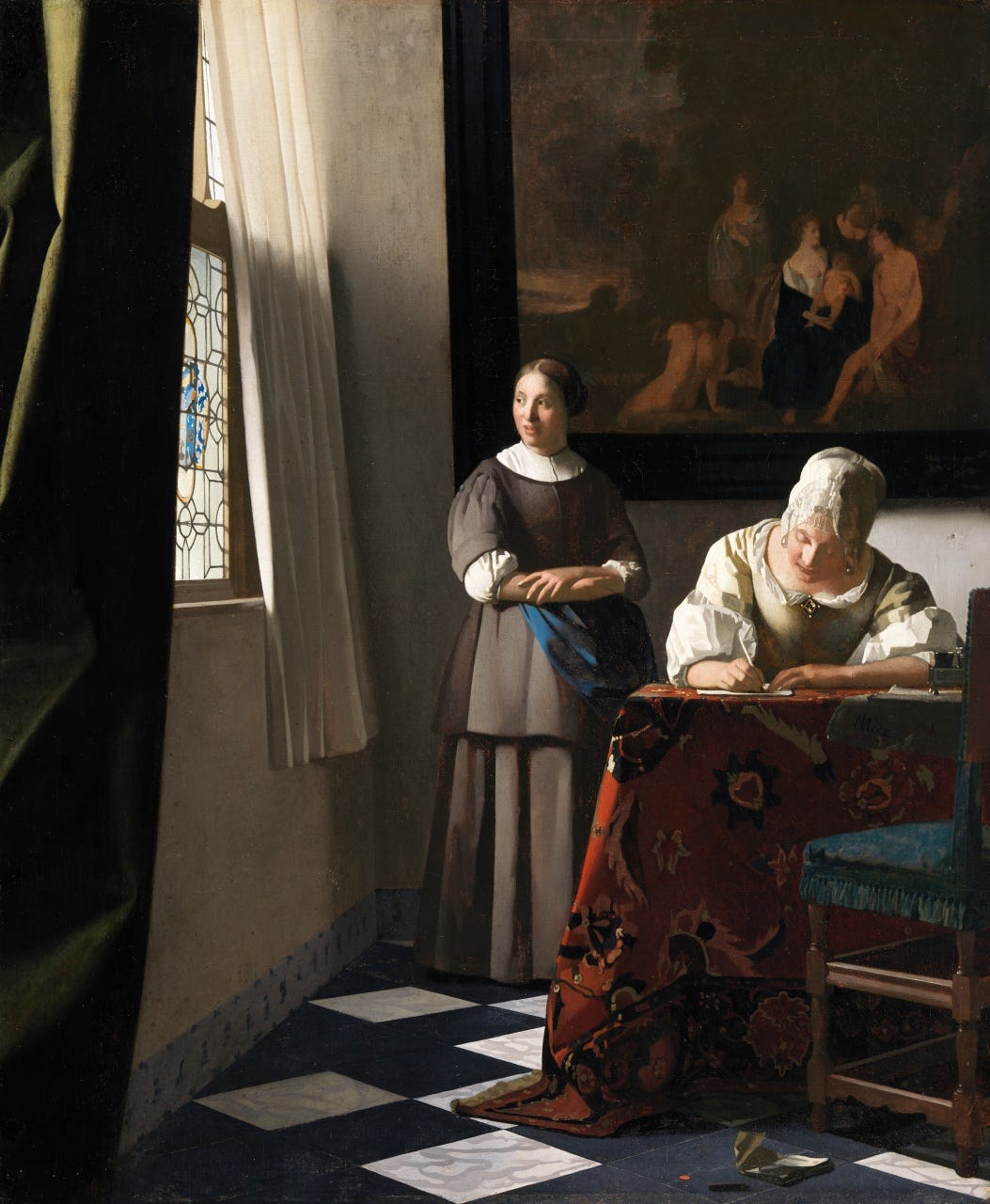
In addition, we shared many great works of art from our collection with museums and galleries around the world. These have included The Taking of Christ by Caravaggio, which was part of Caravaggio 2025 at the Palazzo Barberini, Rome, and Vermeer’s Woman Writing a Letter with her Maid — one of three paintings in Vermeer’s Love Letters, the inaugural exhibition shown in the newly renovated Frick Collection on Fifth Avenue.
Acquisitions are the life-blood of a national public collection and in 2025, we’ve been able to acquire a number of important works, both international and Irish. These include a mischievous self-portrait of 1632-33 by Dutch 17th-century artist Jan Miense Molenaer, showing the painter in his studio; Émile Bernard’s Café-cabaret, and two rare works on paper by the great visionary glass-painter and illustrator Harry Clarke (1889-1931), who his contemporary, the writer George (AE) Russell, called “one of the strangest geniuses of his time.” Harry Clarke is well known in Ireland, but scarcely outside the island.

I’m also invested personally in acquiring more works by female artists. Two acquisitions I want to particularly highlight are Woman in Costume (Self-portrait), c.1917, by Kathleen Fox, and Untitled, c. 1930 by Eileen Gray.
Eileen Gray probably needs no introduction to your readers — thanks to the generosity of the family of a long-term volunteer we have been able to add the first work by this extraordinary Irish artist and designer to our collection. Kathleen Fox is hardly known at all, although she was also a remarkable talent, one of Irish painter William Orpen’s best students. Her life was difficult, and sometimes tragic; like many women artists of her generation her painting has faded into obscurity. I’m very happy that we’ve recently hung her Woman in Costume in our early 20th-century Irish gallery.
You were previously at the National Gallery in London. What are the similarities and differences between the two institutions?
These two galleries are special for me. I’ve known the National Gallery of Ireland since I was a teenager. It was the first place where I formed an abiding relationship with great art. I’ve always loved the experience of looking at art here. And as a student in London, the National Gallery became another museum home, a welcoming place to look and to learn. So to have the opportunity to work at both galleries in senior positions is a huge joy and a privilege.
I think that major collections like these have more similarities than differences — we often work together, and have many long-standing connections and collaborations.
However, I’m struck by the large percentage of the local population who come to the National Gallery of Ireland. In Dublin, more people open up to me about their feelings about ‘the Gallery’ – and taxi drivers have (almost) always heard of it. In my experience that wasn’t necessarily the case in London.
A surprise is that I’m not the only person in Ireland to enjoy both National Galleries. We’re so connected in these islands. Most of us who live on one island have people and experiences we love on the other, including pictures.
What role does NGI play in Ireland’s cultural landscape — and what makes a successful ‘national gallery?’
It has a very special role in Ireland’s cultural landscape, and in people’s hearts and minds.
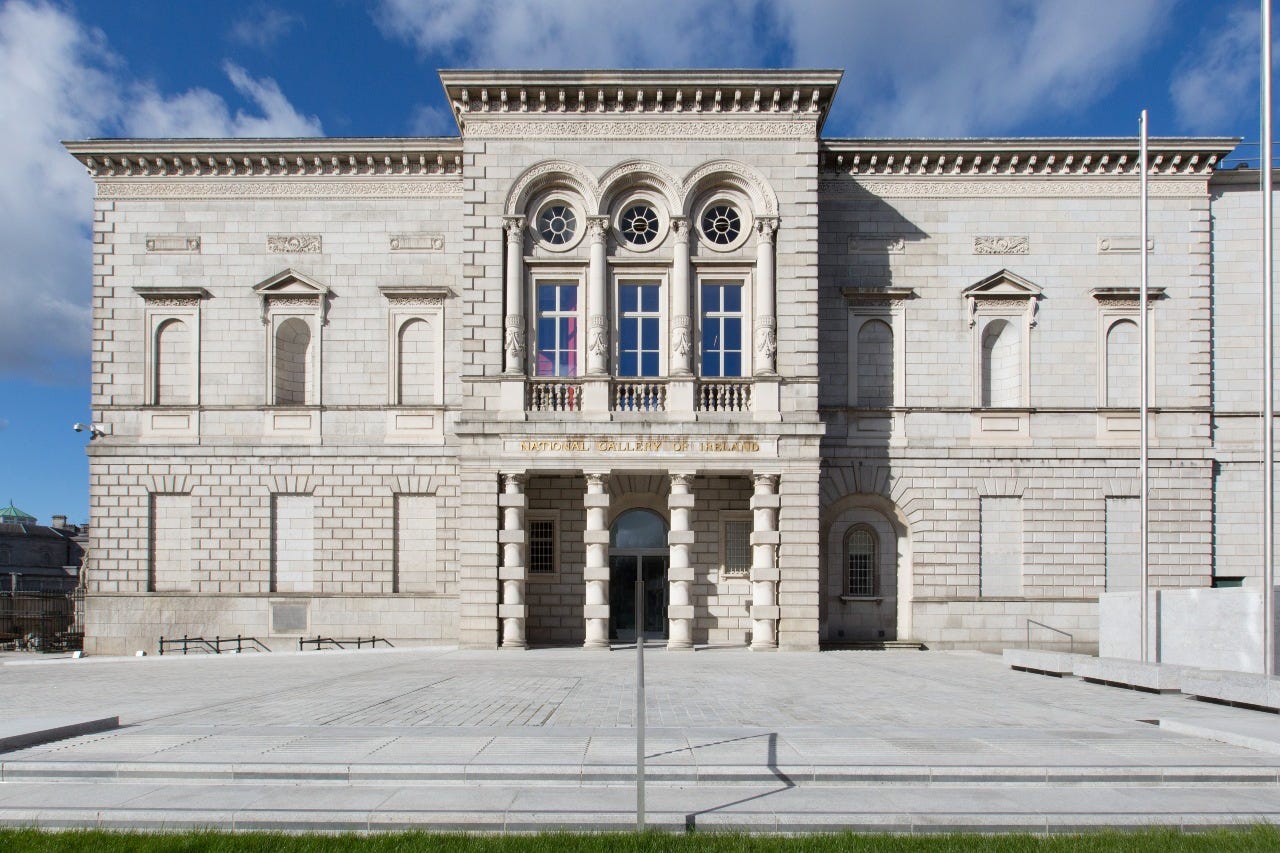
It’s one of the most popular visitor attractions on the island, because of the quality of its collections and the warmth of its welcome. The Gallery was founded over 170 years ago to be for everyone. For that reason it was situated in the heart of Dublin, with good transport links. That mission, to be for all, continues to drive and motivate us today.
The Gallery has changed a lot since 1854. Our collection has grown massively — from less than 100 works of art to over 18,000 — as have our visitor numbers. Our holdings of Western art are encyclopaedic, and yet they reflect the cultural history of Ireland in fascinating ways. The strength of observant Catholicism here in the 19th and 20th centuries is probably the principal reason that we hold one of the world’s very best collections of Southern European Baroque painting. We have a strong research role, and are home to Ireland’s leading research centre for art and art history, as well as to an extensive and growing archive devoted to Irish artists. In 2025 we opened Ireland’s first Scientific Research Laboratory in an art museum, and we have the largest art conservation studio on the island.
What hasn’t changed is our commitment to our visitors. We’re about art and audiences. We’re here to connect the people of Ireland and beyond with great art, of many times and places, including our own. This art is always contemporary as long as it’s being looked at and enjoyed.
That, for me, is what makes a successful national gallery.
There’s a few weeks left of your Picasso exhibition, how would you judge its success?
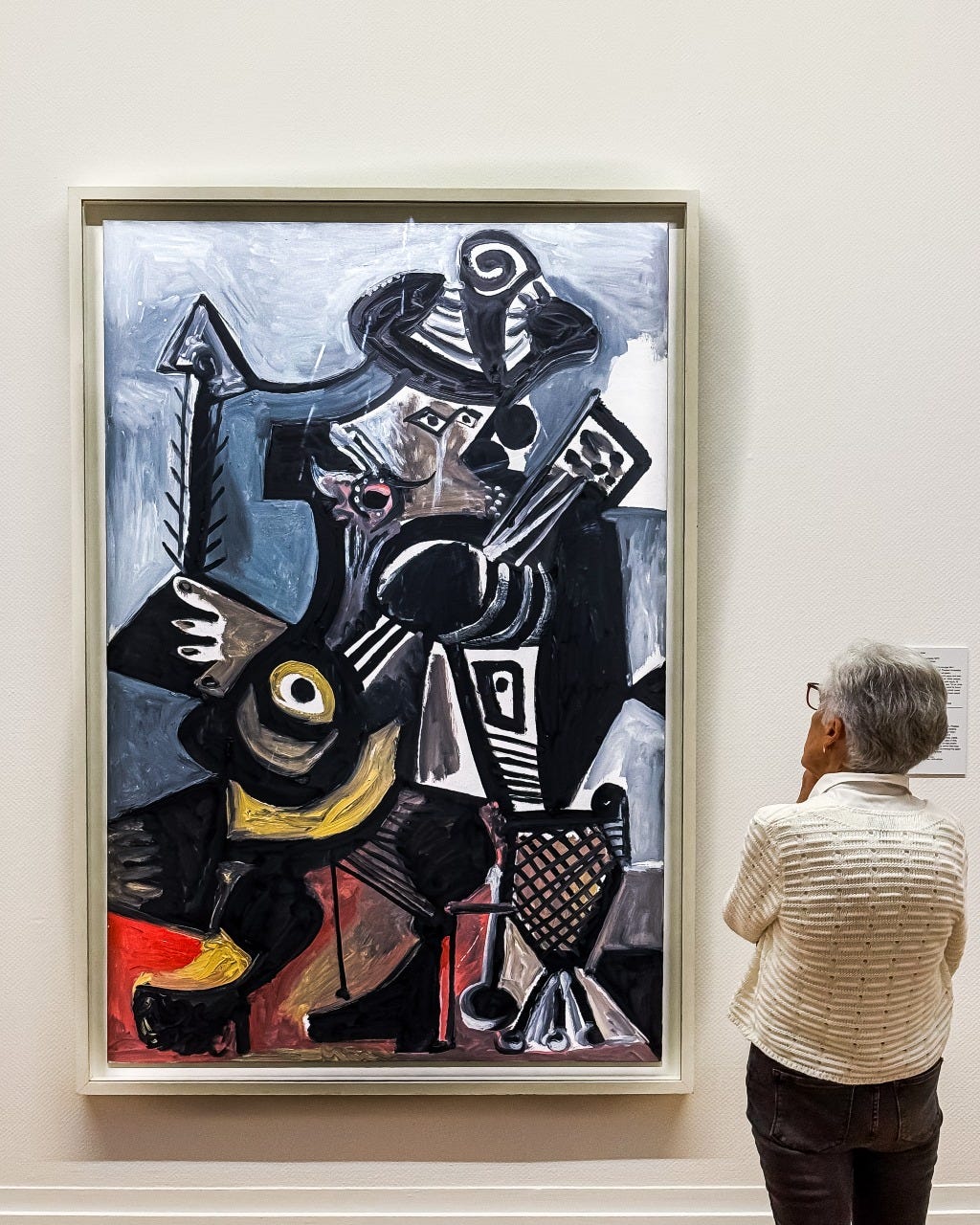
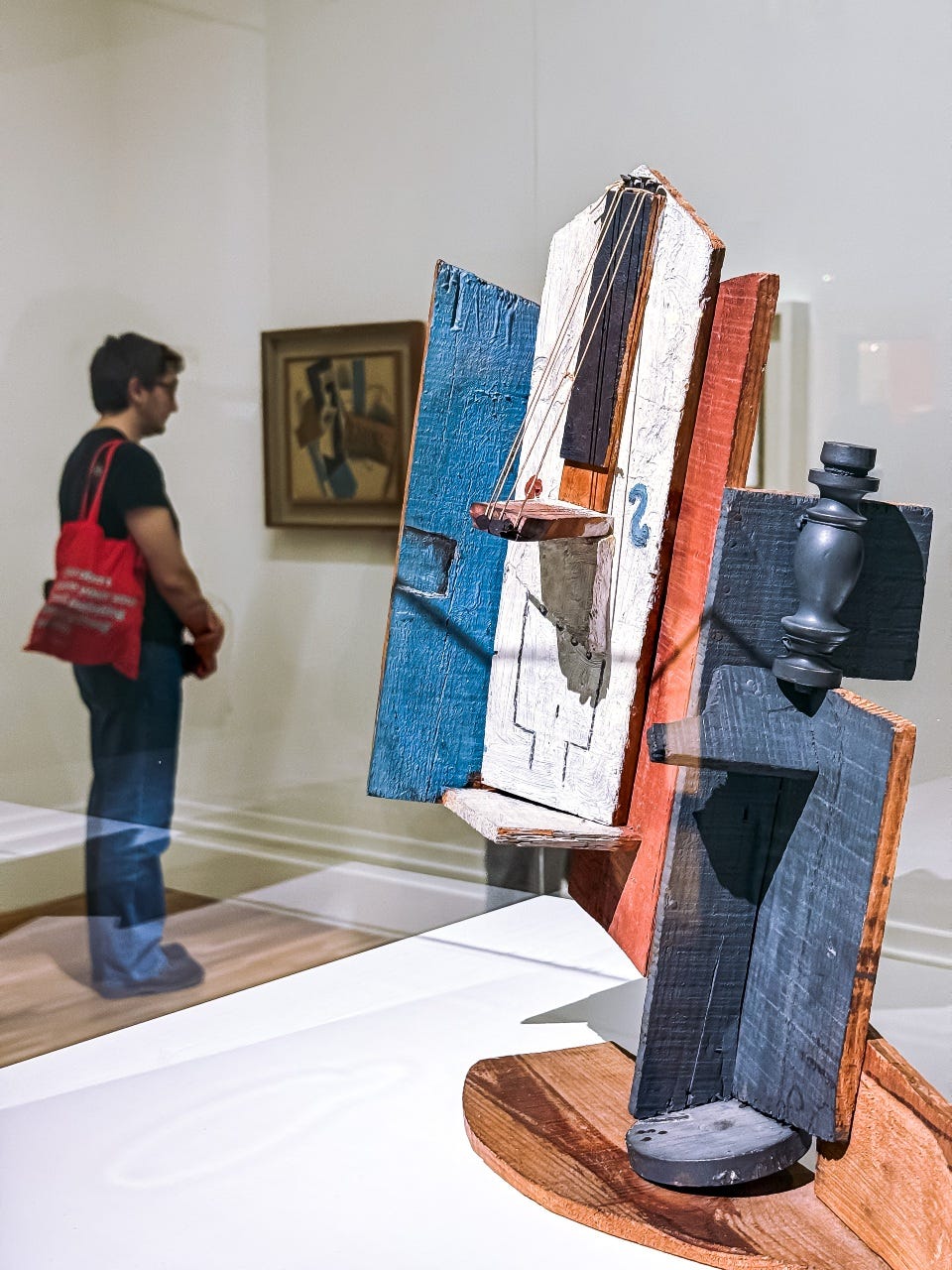
When the exhibition closes, we expect Picasso: From the Studio to be one of the most visited shows presented at the Gallery in recent times. The exhibition situates Picasso’s art in the context of his studios, and includes his monumental Still-Life with a Mandolin, a much-loved part of our twentieth-century collections. It has been very purposeful to share such a comprehensive selection of Picasso’s work in Ireland, thanks to our collaboration with our colleagues from the Musée national-Picasso Paris.
Notably for this exhibition, all schools’ group tickets were sold out within a short period, and we then provided additional spaces for schools. The show also enjoyed our most successful ticket pre-sales to date. We’ve seen a strong retail performance too and an average increase in general visitors to the gallery of 24%, in comparison to the same period in 2024.
The Picasso show seems to be another example of the fact that the bigger the artist on show, the bigger the crowds. Does it make you want to programme more big name artist blockbusters? Especially as it must help the bottom line?
Perhaps no artist has exercised such an enduring influence over their peers during their lifetime as Pablo Picasso. It’d be hard to deny Picasso’s centrality to twentieth-century art, and the wide interest in exhibitions and presentations of his work.
We like to programme a range of artists and exhibitions — both international and Irish. Our vision is to enable people to see both artists that they know they like — such as Picasso, or Irish painter Jack B. Yeats (probably the most admired of Irish artists) — as well as those they can come to love, or those they may not have known before.
For instance, our 2024 Women Impressionists exhibition presented Berthe Morisot, Eva Gonzalès, Marie Bracquemond and Mary Cassatt — of whom, only Morisot and Gonzalès were familiar to our audiences (we acquired a painting by Morisot as early as 1936) — while in the spring and summer of 2025, Mainie Jellett and Evie Hone: The Art of Friendship focused on two very important Irish modernist artists. Essentially Jellett and Hone introduced abstraction to Ireland. They were vilified at the start of their careers — partly because of their gender — and although art lovers were aware of them, they weren’t household names. It’s really pleasing that they’re better known as a result of our exhibition.
The Picasso exhibition is also your first to be fully organised since the Official Languages (Amendment) Act 2021. How has it affected the gallery and what must you now offer?
As we continue to implement and advance our commitment to the Official Languages Act, Picasso: From the Studio is the first ticketed exhibition at the Gallery to be presented comprehensively to our visitors in both Irish and English. As a leading Irish National Cultural Institution, we place equal emphasis on the two languages with our audience.
We’ve an obligation to ensure that all of our press releases and newsletters are provided in dual language versions. In addition, a defined percentage of our advertising and our organic digital media is done in the Irish language. We’re required to respond to any written communication in the language that the original message was written in.
I’m fortunate to be able to converse with colleagues in English, French and Italian, and I started learning conversational Irish some years ago, while living in London. I support the objectives of the Official Languages Act, and I believe strongly in the importance of our native language. As an employer, I admit that it can be challenging to find staff with translation qualifications as well as the high standards of conversational and written Irish that the Official Languages Act requires.
KPMG supported Picasso: From the Studio. Why does a company like that want to come on board to support an exhibition like this?
Major exhibitions like Picasso: From the Studio wouldn’t be possible for us to present without funding from the Irish Government via the Department of Culture, Communications and Sport, as well as the support of corporate sponsors, philanthropic donors, and the income from ticket sales.
Our partnership with KPMG has been an extremely positive one, and we’re very grateful for their support. Without it we wouldn’t have been able to mount and share this exhibition. KPMG is committed to supporting cultural initiatives that enrich society, whilst reaffirming that the cities where they are based are great places to live, work and visit. We’re proud to be part of the cultural ecology that makes Dublin a great city with tangible energy.
And what’s the corporate sponsorship landscape like in Ireland right now?
We never take corporate sponsorship for granted. Every relationship we’ve generated has taken hard work, and an alignment of values and objectives. There is a highly competitive and evolved market for sponsorship in Ireland, and a finite number of corporate sponsors available. I’m fortunate to work with a skilled Development team, who are committed to enable the Gallery to achieve our fundraising goals.
You have a William Blake show coming this year, what can visitors expect?
William Blake: The Age of Romantic Fantasy opens in April, and will run until July. It presents a selection of Blake’s most iconic works of art alongside a group of paintings and drawings by his contemporaries.
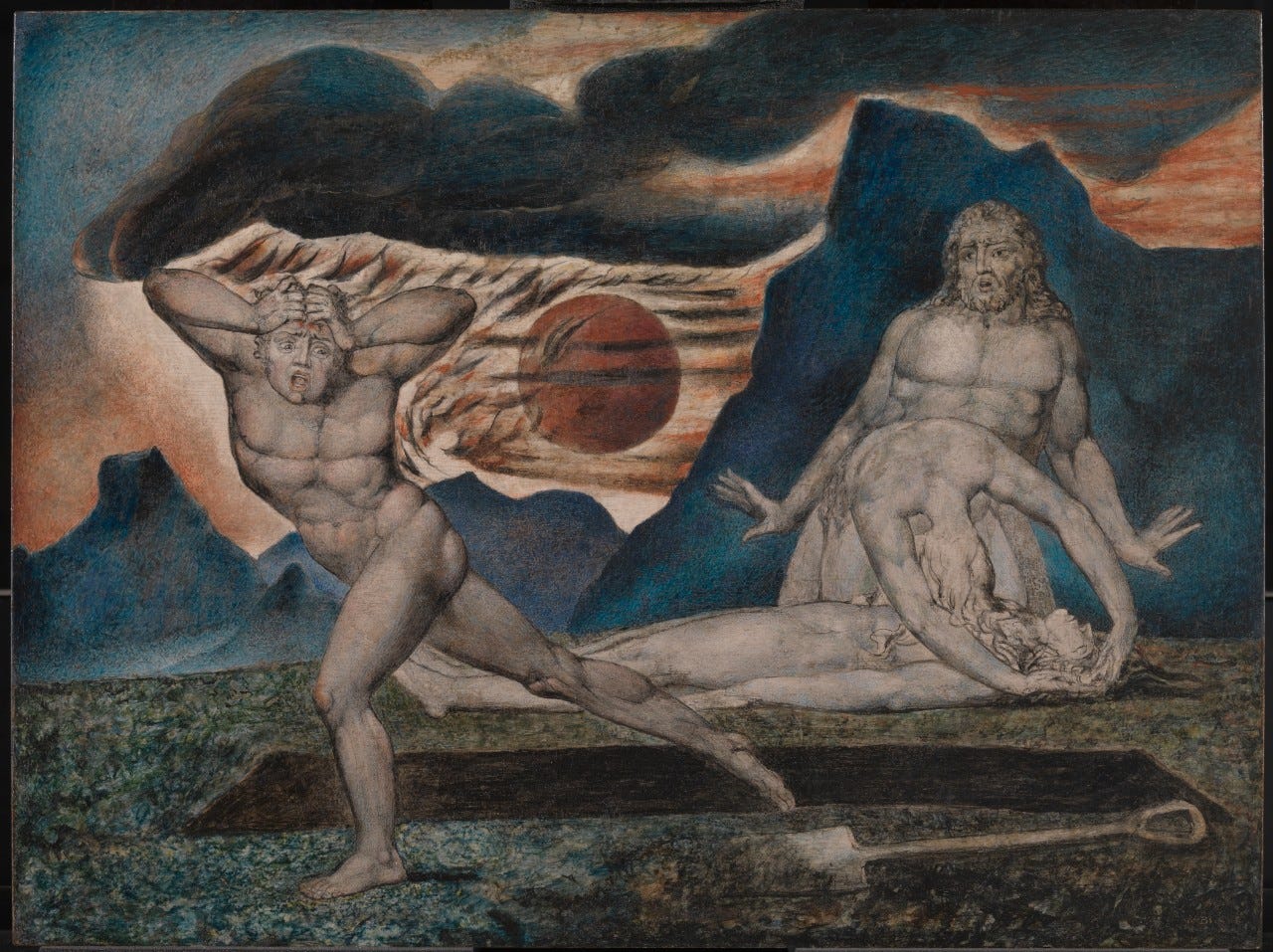
It’s the first exhibition in Ireland to focus on Blake. By placing him in context — among the artists he admired and those he inspired — the show will offer visitors an insight into an era of originality and innovation in late-eighteenth and early nineteenth-century art.
Visitors can expect to see works by James Barry, Henry Fuseli, John Hamilton Mortimer, Thomas Rowlandson, and J.M.W. Turner. It’s a deep dive into the Romantic imagination, the Sublime, the impact of the Enlightenment and the French Revolution on artists active across these islands, through the prism of Blake, one of the most visionary and unique of Western artists and writers.
It’s a touring show from Tate. What are the factors that make you programme a touring show rather than curating your own? Is it just to fill a gap in the schedule?
Blake’s desire to escape from some of the shocks and changes of his own age, as well as to envision a new, better world has many resonances for us. This exhibition is part of a year of programming at the National Gallery of Ireland that addresses visionary artists – J. M. W. Turner, Blake and Hilma af Klint. When our colleagues at Tate approached us about potentially showing this exhibition in Dublin, my team and I embraced this, because Blake’s art is concentrated in very few public collections worldwide – one of which is Tate. It’s scarcely seen outside these institutions. This show is a rare opportunity for Irish audiences to learn about and appreciate his paintings, drawings and prints, in connection with his poetry.
It’s also the case that Blake’s work has been an abiding stimulus for many major Irish cultural figures, including W. B. Yeats, Oscar Wilde, James Joyce, Francis Bacon, U2 and Van Morrison. In the publication for our show, Professor Christina Morin places Blake in the context of ‘Irish Gothic’ writings of the 18th and 19th centuries, while Anne Hodge draws attention to the fact and fantasy of Blake in Ireland, from Yeats’s assertion of Blake’s Irish origins, to the more demonstrable evidence of his impact on Yeats and others.
Finally, for readers who are coming to Dublin this year, what paintings from the collection should they absolutely hunt out to see?
Perhaps the most loved works of art on display are Caravaggio’s The Taking of Christ, Johannes Vermeer’s Woman Writing a Letter with her Maid, and Jack B. Yeats’ The Liffey Swim.
Other works are popular with our visitors include Goya’s Doña Antonia Zárate, Monet’s View from Argenteuil and a beautiful watercolour by Frederic William Burton (Director of the National Gallery in London from 1874-94), The Meeting on the Turret Stairs, that we display in a special light-controlled cupboard so that we can show it to visitors several times a week. Some years ago it was voted Ireland’s favourite painting; it’s reproduced in Dublin’s registry office, and people regularly get engaged in front of it.
Particular favourites of mine include The Artist’s Studio by John Lavery, a Vase of Flowers with an Ear of Corn by Rachel Ruysch, and Lavinia Fontana’s The Visit of the Queen of Sheba to King Solomon (restored in 2019-20 with a grant from the Bank of America Art Conservation Programme).
There’s nowhere better than the National Gallery of Ireland to see Irish art, and apart from the works of Jack B. Yeats, I’d encourage visitors to look out for Hugh Douglas Hamilton’s Cupid and Pysche, Mainie Jellett’s Decoration, Louis Le Brocquy’s A Family and Harry Clarke’s stained glass, including The Enchantment of Bottom by Titania and The Mother of Sorrows.
I regularly lead a Director’s Tour in our galleries — if you come along you will discover more new additions to our displays as well as hear more about some of my current favourites.
Is there anything else you’d like to mention that I’ve not covered?
I grew up in Northern Ireland during the Troubles. The National Gallery of Ireland provided a place of solace and delight to me during that period. I find it reaffirming to know that during times of uncertainty and even conflict, the National Gallery is there to provide a calming and inspirational space for everyone.
Picasso: From the Studio runs until 22 February. William Blake: The Age of Romantic Fantasy opens 16 April 2026.
What a brilliant interview!