
EXCLUSIVE: "Exceptionally rare” Egyptian antiquity heads to auction
First ever sale of 4,000 year old sculpture

Wednesday 03 June 2026
What’s happening in museums, galleries, art and heritage
Happy Wednesday.
Here in today’s edition, I’m bringing you a bone fide art world exclusive. You are the first people in the world to be publicly told this…
Later this month, one of the very first Ancient Egyptian artworks to have arrived in Britain will go to auction. It has never gone under the hammer before in its recorded history.
The 4,300-year-old funerary sculpture is an “exceptionally rare” artwork from the Old Kingdom, and it was once owned by King George III. It’s been in a private collection in Yorkshire for the past 250 years.
I can reveal today that it’ll feature in The Exceptional Sale at Christie’s in London at the end of June, part of their twice-yearly Classic Week sale season. The sculpture has a price estimate in the region of £3m.

It is striking, and beautiful. It’s an Egyptian pair statue of the Royal Acquaintances Nebefwy and Mes-sat, dating to the Old Kingdom — circa 2400–2300 B.C. It’s been in the collection of Hovingham Hall in North Yorkshire since being gifted by George III around 1778, but it arrived on these shores a number of years earlier. Few Egyptian antiquities pre-date it on these isles.
Today, only a handful of figures from Egypt’s Old Kingdom are in the UK, and very few of this quality are in private ownership anywhere in the world. So when it heads to auction, it’s expected there’ll be significant interest from collectors and institutions globally. It will also go on public display ahead of the sale.
I’m excited therefore, to bring you today’s interview — with the woman who is stewarding this momentous sale.
Share this exclusive news 📲
Hannah Solomon is International Head of Antiquities at Christie’s, and based in New York. She joined the department in 2010 and oversees the auctions in NYC as well as the bi-annual Classic Week sales in London.
Here in my exclusive chat with Hannah, she gives me the scoop on this landmark moment, and reveals why this ancient sculpture is so remarkable.
We dive deeper into the object’s provenance and how she goes about piecing together its ownership history. Plus, we also discuss the wider antiquities market, how she works with museums, and she explains what it’s like to be in the room when the hammer comes down on a record price.
Let’s dive in!
maxwell
The Big Interview 🗣️
with Hannah Solomon, International Head of Antiquities at Christie’s
Hello Hannah. So firstly, this is an incredible piece. Tell me about what makes it so special.
This pair statue is truly exceptional.
First and foremost because it captures both artistic refinement and human intimacy at the height of Old Kingdom sculpture. It depicts Nebefwy and Mes-sat, an elite couple from Memphis — Egypt’s first unified capital and the administrative and religious centre of the period — shown in a close, almost protective embrace that is unusually tender for the period. It was carved in limestone and would have stood in a funerary context within a mastaba tomb.
What is so remarkable about it is the combination of scale, sensitivity of modelling, and the unusually complete inscription naming not only the couple but also their son, Meh-er-nefer, who dedicated the monument. It is both portrait and memorial.

And it’s very rare isn’t it?
It is exceptionally rare. Only a small number of Old Kingdom pair statues survive, and even fewer retain this level of preservation and sculptural refinement. Within private ownership, examples of this quality can effectively be counted on one hand.
Most comparable works are held in major institutional collections such as the Egyptian Museum in Cairo or the Metropolitan Museum of Art in New York. What distinguishes this example is its completeness: both figures, their intimate composition, and the full inscriptional programme remain intact. It is the kind of work that very rarely appears on the market.
That exceptional preservation — why is that, what has kept it so well preserved?
Its exceptional state of preservation is partially due to luck of survival from antiquity, as well as its clear importance to those who have owned it during its modern history.
It was well cared for by its owners, Sir James Porter, who gifted it to King George III, who in turn gifted it to Thomas Worsley, who kept it at Hovingham Hall until it left to come to Christie’s. Thomas Worsely had a clear interest in and passion for the ancient world, as witnessed by his Palladian-style hall he designed himself between 1750-1770, inspired by his travel to Florence.
How and why was it brought to Britain by Sir James Porter? How did he come to own it?
Sir James Porter was British Ambassador to the Ottoman Empire in Constantinople [from 1747 to 1762], a position that placed him at the centre of diplomatic and cultural exchange in the eastern Mediterranean during the 18th century.
Objects such as this Egyptian sculpture often entered European collections through networks of diplomatic gifting, antiquarian collecting, and the movement of antiquities through Ottoman-controlled regions. While we cannot reconstruct every step of its earlier journey, what is clear is that by the time Porter presented it to George III, it was already regarded as a highly significant antiquity. That early arrival places it among the very first Egyptian sculptures known in Britain.
⚠️ Exclusive stories like this take time and effort. Your support helps continue this work. Thank you.
Why was it gifted to King George III?
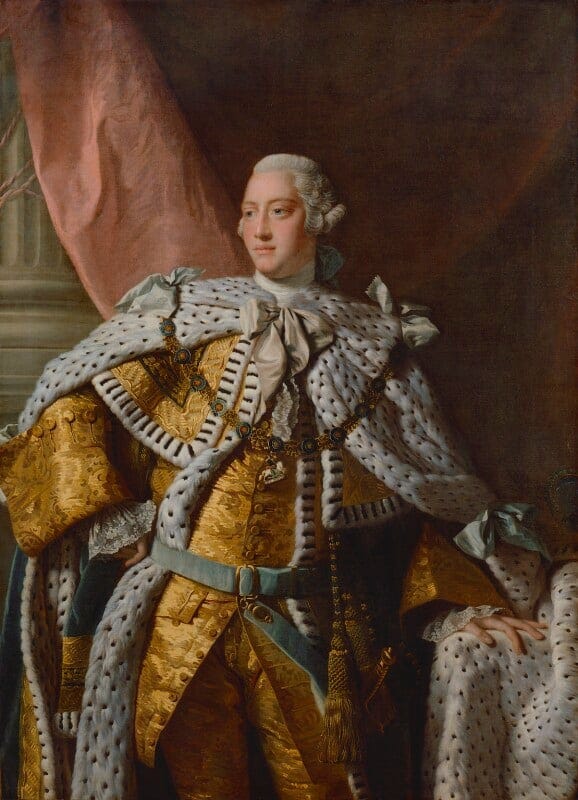
After being in Sir James Porter’s possession, the statue was presented to King George III, likely as part of the ambassadorial culture of gifting objects of cultural and diplomatic significance to the Crown. George III had a well-documented interest in antiquities and natural history, and objects of this nature were often incorporated into royal collections at Windsor or other royal residences.
The King subsequently gifted the statue to Thomas Worsley of Hovingham, a close associate, which reflects both personal favour and the 18th century practice of circulating important works within elite intellectual and social networks.
How do you go about researching and confirming provenance like this?
It is a process of assembling multiple strands of evidence rather than relying on a single document.
We begin with the object itself: inscriptions, condition, and any early markings. We then work through archival records — family papers, sale histories, museum documentation, early publications, and correspondence. In this case, the Hovingham archives were crucial, as the statue has been recorded there since 1778. We also cross-reference diplomatic histories, especially relating to Sir James Porter and George III’s collecting practices.
It is meticulous work, often involving collaboration between specialists and scholars where individual fragments gradually form a continuous and coherent history.
Send this exclusive news to a colleague 📲
And perhaps can you also talk us through how an object like this comes to Christie’s.
It often begins quietly, through long-standing relationships with families or advisors who have cared for collections over generations. In this case, the object has been known within the Hovingham context for centuries, so the conversation is less about discovery and more about timing and stewardship.

Once a potential consignment is identified, we undertake detailed due diligence, condition assessment, and scholarly research, then position the work within the right sale context globally.
For a piece of this importance, everything is considered — from publication strategy to exhibition presentation. The goal is to ensure it is seen, understood, and properly contextualised for the market and institutions worldwide.
Presumably you expect significant demand for the sculpture. Do you have a sense of potential buyers already?
For a work of this calibre, interest tends to be international and highly diverse, spanning institutional buyers and major private collectors.
Egyptian Old Kingdom sculpture of this quality is almost never available, so engagement tends to be immediate and global. Rather than focusing on a single category of buyer, the emphasis is on ensuring the widest possible scholarly and collecting audience is engaged. It is also brilliant that it will be on view ahead of the sale at Christies King Street for all to see.
👀 WATCH: Christie’s record-breaking $181m Jackson Pollock sale in New York in May
What is Classic Week, which this work will be sold in?
Classic Week is one of Christie’s key London calendar moments — held in both summer and winter — bringing together a series of auctions and exhibitions dedicated to exceptional works across centuries. It spans antiquities, Old Master paintings, European sculpture, rare books, prints, and masterworks across cultures.
The week creates a concentrated platform for museum-quality works, important private collections, and outstanding objects of historical significance. This summer’s programme runs with public exhibitions open from 26 June to 08 July, offering free access to a wide range of works before the auctions begin.
How is the general health of the antiquities market currently, in your view?
It remains selective while deeply resilient. The strongest works — those with impeccable provenance, museum-level quality, and fresh-to-market status — understandably continue to attract global competition.
There is also an appreciation for connoisseurship and historical importance, rather than purely decorative appeal. When exceptional works appear, particularly from long-held collections like Hovingham, they tend to perform very strongly because they combine rarity with trust and transparency.

Do you work with museums in your role?
Very closely, and on a regular basis. Museums are incredibly important to our field of ancient art.
We have a healthy dialogue and relationship with many curators and administrators at museums worldwide, collaborating on scholarship, provenance research and objects that are both acquired and sold. Curators are especially important for Christie’s during our scholastic research of our catalogues. We also greatly appreciate working with curators on potential deaccessions or acquisitions depending on the situation. We also engage them early when something of particular significance is coming to market, ensuring they have time to consider acquisitions or funding opportunities.
The relationship is supportive and collaborative rather than transactional. Some of the most important objects we handle ultimately enter public collections — either by loan or by donation — and that long-term cultural outcome is always part of how we think about placement.
Are there still spectacular antiquities in private collections that no one knows about, that one day might be revealed?
Yes — and that is one of the most exciting aspects of the field for me. I love the pursuit of objects that have been in private collections for generations or that are said to never be available. All one can do is consistently keep working with collectors and hoping that one day will be the time that a sale is possible.
And sometimes an object emerges that has been lost or forgotten about, which is truly a masterpiece. One hopes for an object that has been unseen for decades, or even longer, and re-enters the scholarly and public conversation in a way that feels almost like rediscovery.
Finally, you’ve been responsible for a number of recording-breaking results at Christie’s. How does it feel when you see a hammer go down in these moments?
It is always a mixture of focus and adrenaline. During the bidding, you are completely absorbed in the rhythm of the room. When the hammer finally falls, I experience a moment of stillness almost as though time pauses briefly. Overall, I am delighted that the work has found a new home and that the seller has achieved their desired outcome.
But you have dedicated so much of yourself to an object for potentially years and then it’s over before you know it. And then you are quickly on to the next challenge!
The Exceptional Sale: Masterworks Across Cultures will be held on 30 June at 16:30 BST. It will be broadcast live on Christies.com. The accompanying exhibition will be on view from 26—30 June at Christie’s London and admission is free.
⚠️ Exclusive stories like this take time and effort. You can support me and this newsletter here — it’s quick, and any amount helps. Thank you.
CATCH UP

